


Blog Post
How Caffeine Slows Cellular Aging
Your daily cup of coffee or tea might hold more power than you think. It could be actively helping your body combat the aging process. New research from scientists at Queen Mary University of London and the Francis Crick Institute helps explain how this works. For years, scientists have seen a link between caffeine and better health, and this study discovered reaction it triggers within our bodies.
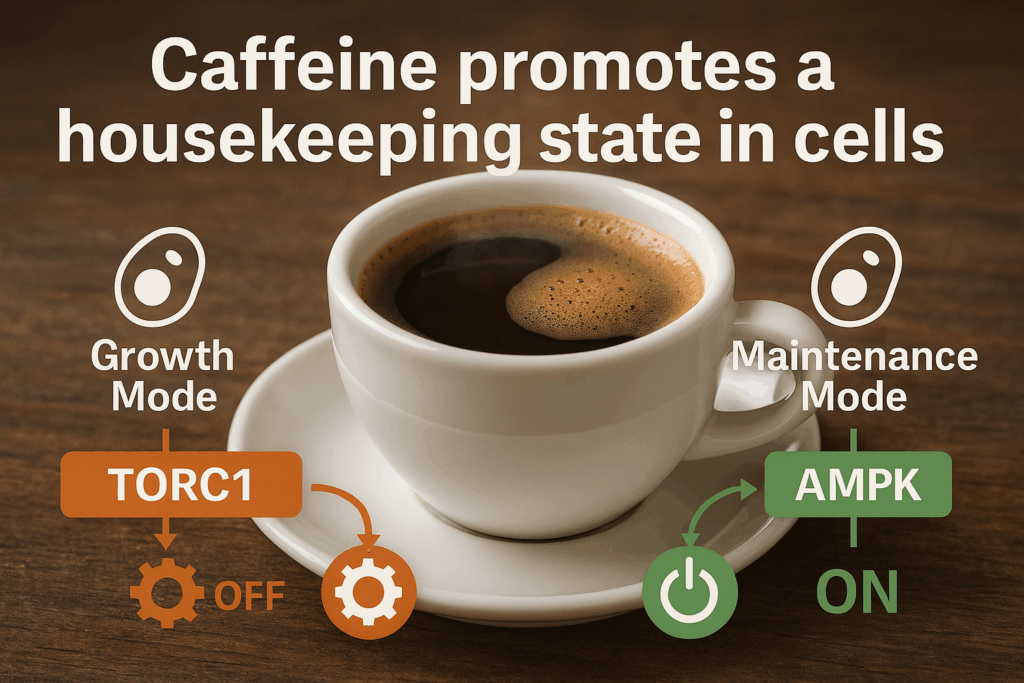
To understand what caffeine does, it helps to know that our cells generally operate in one of two modes: “growth mode” or “maintenance mode.” Growth Mode is when a cell puts all its energy into growing and dividing. While important for development, staying in this mode constantly makes cells tired and is linked to faster aging. The main controller of this process is a pathway called TORC1. The “Maintenance Mode” is a protective, self-preservation state. In this mode, the cell slows down on growth and instead focuses on housekeeping. It cleans out waste, repairs damage to DNA, and recycles old parts to keep itself running efficiently. The master switch for this process is an enzyme known as AMPK.
For a long time, it was believed that caffeine worked by directly telling TORC1 to ease up. But this new study found a cleverer approach. The researchers found that caffeine’s first stop is to activate AMPK. By flipping this switch, caffeine puts the cell on alert, signaling that it’s time to conserve energy and focus on repairs. It is this maintenance system that then sends a signal to tone down the TORC1 pathway. This discovery clarifies that caffeine isn’t just a simple inhibitor; it actively promotes a housekeeping state in our cells.
The scientists proved this connection in an interesting experiment. When they studied yeast cells that had a “broken” maintenance switch (their AMPK system was missing), caffeine no longer had the ability to extend their lifespan. This showed that the AMPK maintenance system is the essential key component for caffeine’s anti-aging benefits.
While this research was done in yeast, it has exciting implications for humans. AMPK and TORC1 are ancient systems that have been preserved through evolution and are important in our own bodies. This work helps provide a scientific explanation for why so many large-scale human studies have connected regular caffeine consumption with positive health outcomes. So, as you sip your next coffee or tea, you can appreciate the complex and beneficial work it might be doing. -XL STAFF
